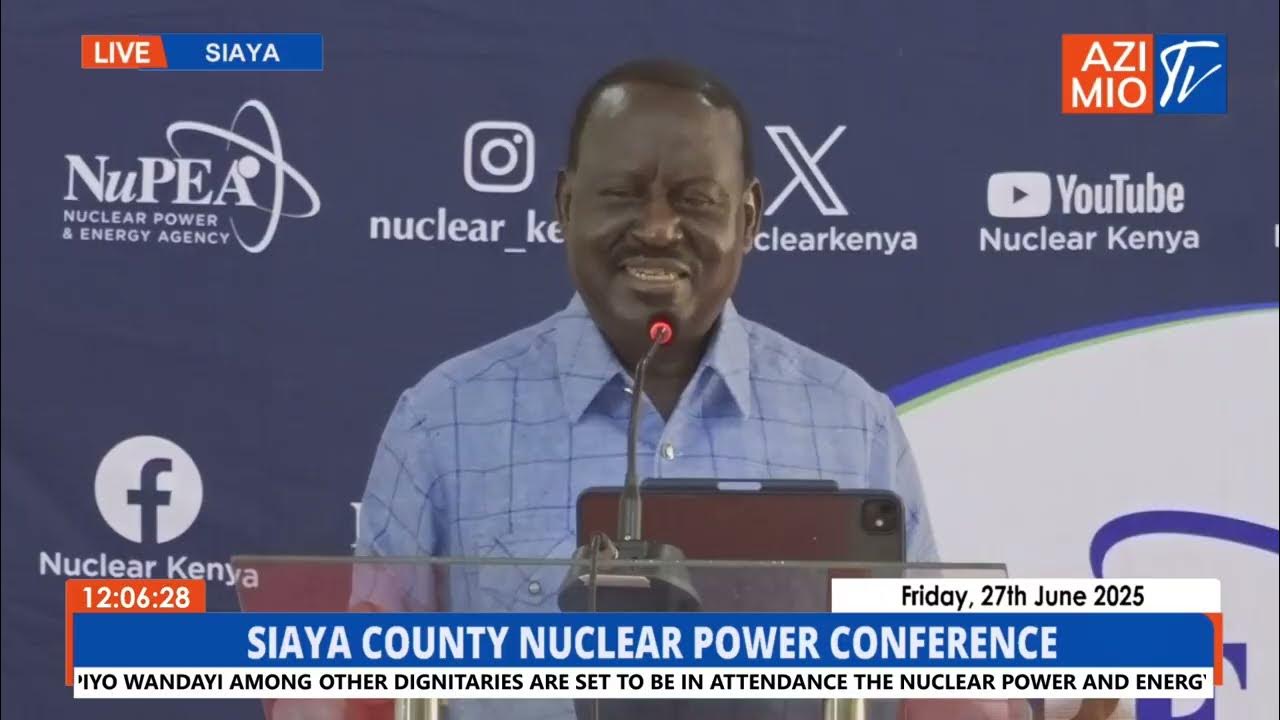
Kenya’s government has unveiled plans to construct the country’s first nuclear power plant in Siaya County by 2030, marking a pivotal shift in the nation’s energy strategy as it seeks to expand capacity from 3,400 megawatts to 60,000 megawatts to support large-scale industrialization.
The announcement, made during a stakeholder engagement at Jaramogi Oginga Odinga University of Science and Technology, signals Kenya’s entry into the global nuclear energy market and positions the East African nation to compete for energy-intensive manufacturing investments.
The selection of Siaya County in the Lake Victoria region reflects careful economic planning, with proximity to the lake providing essential cooling water infrastructure while positioning the facility to serve both domestic and potential regional export markets. The location could establish Kenya as a regional energy hub for the East African Community’s growing industrial base.
Energy Cabinet Secretary Opiyo Wandayi emphasized the project’s alignment with Vision 2030, Kenya’s long-term development blueprint focused on transforming the country into a middle-income industrialized nation.

“Kenya remains committed to implementing the nuclear power programme while adhering to the highest possible international standards,” Wandayi stated, highlighting the government’s focus on attracting international investment and technology partnerships.
The country’s current energy mix of hydro, wind, solar, and geothermal sources has proven insufficient to meet the country’s industrial ambitions, creating a significant market opportunity for nuclear technology. The 17-fold capacity increase target represents one of the most aggressive energy expansion plans in sub-Saharan Africa.
The Nuclear Power and Energy Programme (NuPEA) has identified this capacity gap as a critical constraint on Kenya’s ability to attract manufacturing investments and compete in global supply chains.
Industries requiring consistent baseload power—including textiles, steel production, and data centers—have increasingly looked to other markets due to Kenya’s energy limitations.
Kenya has advanced to Phase 2 of implementation under the International Atomic Energy Agency’s milestone approach, indicating significant progress in regulatory frameworks and technical preparation.
This advancement opens opportunities for technology partnerships with established nuclear nations and positions Kenya to access international financing mechanisms.
Former Prime Minister Raila Odinga, attending the stakeholder meeting, advocated for partnerships with advanced nuclear countries to ensure technology transfer and capacity building.
Such partnerships typically involve multi-billion dollar agreements encompassing reactor supply, fuel cycle services, and long-term operational support.
The nuclear program promises substantial economic impacts beyond electricity generation. Construction of nuclear facilities typically generates thousands of direct jobs and creates demand for specialized local suppliers.
The project is expected to catalyze development of technical education programs and research capabilities, with NuPEA Chairman Prof. Larry Gumbe announcing plans for an MOU with local universities for nuclear technology training.

Local political leaders, including Bondo MP Dr. Gedion Ochanda and Ugenya MP David Ochieng, have welcomed the project while emphasizing the need for community engagement to address public concerns about nuclear safety.
Their support reflects expectations that the facility will drive regional economic development and job creation.
The nuclear program positions Kenya to become a regional energy exporter, potentially supplying power to neighboring countries through the East African Power Pool.
This could generate significant foreign exchange earnings while supporting Kenya’s ambitions to become a regional manufacturing and logistics hub.
Senator Dr. Oburu Odinga, chair of the Senate Energy Committee, emphasized the thorough research behind the nuclear decision, noting that modern nuclear technology offers safe, efficient, and environmentally responsible power generation that complements renewable energy sources.
The nuclear announcement signals Kenya’s commitment to providing the energy infrastructure necessary for heavy industry and manufacturing.
This could influence location decisions by multinational corporations considering African manufacturing bases, particularly in sectors requiring reliable, high-capacity power supplies.
The project also demonstrates Kenya’s willingness to make long-term infrastructure investments, potentially improving the country’s credit profile and attractiveness to international investors across multiple sectors.
While the nuclear program offers significant economic opportunities, success will depend on securing international financing, maintaining political consensus, and effectively managing public concerns about nuclear safety.
The timeline to 2030 requires rapid progress in regulatory approvals, technology partnerships, and construction planning.
The announcement comes as global nuclear markets experience renewed interest driven by energy security concerns and climate commitments, potentially providing Kenya with favorable conditions for accessing technology and financing for its nuclear ambitions.


Ray ID: 8f3a2c1b9d4e5f6a · Performance & security by Cloudflare
site-verification-ok