In a world where 80 is the new 60, most people still think old age starts at 66 and aren’t excited about it.
A shocking new study spanning 32 countries has uncovered a startling paradox: while humans are living longer and healthier lives than any generation in history, we’re still mentally stuck in the past when it comes to aging—and most of us are absolutely dreading it.
The massive Ipsos survey of nearly 24,000 people reveals that despite all our medical advances and increased longevity, 57% of people worldwide say they’re NOT looking forward to their old age. Only 38% are actually excited about getting older.
But here’s where it gets really wild: We’re spectacularly bad at aging math.
Take Mexico, where people think a whopping 30% of their population is over 65—when the reality is just 8%. That’s off by more than 300%! Across the globe, country after country massively overestimates how many old people they actually have.

“It’s like we’re living in some kind of collective delusion about aging,” explains the report. “We see old people everywhere, but the data shows most countries have far fewer elderly residents than people think.”
Here’s the kicker: People expect to live to 78 on average, but they also think “old age” begins at 66. That means we’re planning for 12 years of dreaded old age—and most of us aren’t looking forward to a single day of it.
Some countries have it even worse. In Hungary, people think old age starts at 65 but only expect to live to 64. Talk about pessimistic!
Meanwhile, Filipinos and Indonesians are planning for a whopping 17 years of old age—the longest stretch globally.
The survey exposes some uncomfortable truths about how we view aging in the workplace:
- Only 29% think someone can lead their country at any age
- In 16 countries, the current leader is actually older than what citizens consider “too old” for the job
- The magic number? 61 is when people think you become too old to lead
The Youth Paradox
In perhaps the survey’s most ironic finding, young people are more excited about getting old than people who are actually closer to being old. It’s like being excited about skydiving when you’re on the ground versus when you’re actually standing at the airplane door.

The enthusiasm for aging also rises with income and education—suggesting that maybe old age isn’t so bad if you can afford it and understand it better.
There’s one thing the world agrees on: ages 28-35 are peak life milestone years. This is when people think you should get married, buy a house, and have babies. It’s like the universe has designated this narrow window as “life’s prime time.”
But even here, attitudes are surprisingly rigid. Many people think there’s a cutoff age for major life events—though thankfully, large percentages in progressive countries think there’s “no age too old” for things like starting university or getting married.
With life expectancy climbing and people staying healthier longer, why are we still mentally trapped in outdated ideas about aging? The survey suggests our perceptions haven’t caught up with reality.
As one researcher put it: “Even as our life expectancy is increasing and many of the life stages that people go through are gradually creeping upwards, our perceptions of when is the right time to do those things is not keeping up.”
We’re living in the greatest era for human longevity in history, yet most of us are approaching our extra decades with all the enthusiasm of a root canal appointment.
Maybe it’s time to update our aging software—because whether we like it or not, most of us are going to get a lot more practice at being old than previous generations ever did.
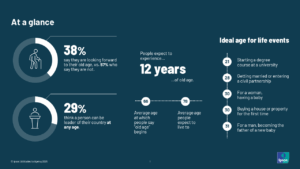
The Ipsos Attitudes to Ageing 2025 survey interviewed 23,745 adults across 32 countries between January 24 and February 7, 2025.


Ray ID: 8f3a2c1b9d4e5f6a · Performance & security by Cloudflare
site-verification-ok